-
The questions that actually come up when a deadline is on the line
-
1. What exactly is RB5, and why does it keep showing up?
-
2. Where are Qualcomm chips manufactured?
-
3. What is the Qualcomm Alphawave acquisition, and why is it about AI data centers?
-
4. Which Qualcomm chip is in the best mobile phone?
-
5. Which Qualcomm group should I talk to for a small order?
-
6. How do I get Qualcomm technical help when a deadline is about to blow?
-
7. Do I need a Qualcomm license to use RB5 in a product?
-
1. What exactly is RB5, and why does it keep showing up?
Not going to make you read a long intro. In my role coordinating emergency supply and technical fixes for small OEMs, I've had to answer these Qualcomm questions while a deadline was running out—more than once from a customer who just realized the project was behind schedule. Each answer can stand alone, so jump to the one you need.
The questions that actually come up when a deadline is on the line
1. What exactly is RB5, and why does it keep showing up?
RB5 is Qualcomm's robotics development platform, built around the QRB5165 processor. It's aimed at drones, delivery robots, industrial automation, and other edge devices that need computer vision plus AI inference. According to Qualcomm's product information on qualcomm.com, the platform supports 15 TOPS of AI performance. That matters because it means you can run real AI workloads on the device instead of sending everything back to a data center. It also integrates Wi-Fi, Bluetooth, GPS, and a camera subsystem, so you don't have to spend weeks hunting for separate modules. If you're under deadline, an RB5 dev kit can save you weeks. I learned that in March 2024, when a client needed a working robot proof-of-concept for a trade show. A custom board would have taken months. An off-the-shelf RB5 board got us there. The surprise wasn't the horsepower. It was how much time the software BSP already saved us.
2. Where are Qualcomm chips manufactured?
Qualcomm is fabless. It designs Snapdragon processors, modems, RF front-end, and AI accelerators, but it does not own the factories. Manufacturing is outsourced mainly to TSMC and Samsung Foundry. Inside Qualcomm, the semiconductor group that handles this is QCT—Qualcomm CDMA Technologies. If you want to think of it as the manufacturing-focused group in Qualcomm's product organization, that's close enough. The practical takeaway is that lead times depend on foundry capacity, not just on Qualcomm. In Q4 2024, I got a 14-week lead time quote for a Snapdragon module from one distributor while another had 250 units in stock. Same part number. Check available-to-sell stock before you commit to any schedule.
3. What is the Qualcomm Alphawave acquisition, and why is it about AI data centers?
The Qualcomm Alphawave acquisition looks strange if you only follow Snapdragon phones. Alphawave Semi builds high-speed connectivity IP and custom silicon. Those are exactly the pieces that AI data centers need when accelerators have to move huge amounts of data. Qualcomm already had Cloud AI 100 for inference, but this deal adds serious interconnect expertise and custom chip design capability. According to Alphawave Semi and Qualcomm's public announcement in 2025, the goal is to expand in data center and AI. I didn't fully understand this until I looked at AI data center bottlenecks. The challenge is not just compute; it's how fast the chips can talk to each other. This acquisition is about the pipes as much as the processors. If your project is edge AI or robotics, this doesn't change your roadmap today. If you're evaluating server accelerators, watch what Qualcomm does after the deal closes.
4. Which Qualcomm chip is in the best mobile phone?
There is no single best mobile phone. The best one for you depends on how you use it. For flagship performance in early 2025, Snapdragon 8 Elite is the top Qualcomm chip in Android flagships. For a better balance of price and battery life, the Snapdragon 7 series usually makes more sense. But the chip alone doesn't decide the phone. Thermal design, screen quality, camera tuning, software updates, and carrier band support all matter. The same Snapdragon can feel great in one phone and average in another. So if you see 'best mobile phone' in a review, read the reasoning behind it instead of the headline. In a production project, the same rule applies. The best chip is the one your team can actually support over the product lifetime.
5. Which Qualcomm group should I talk to for a small order?
Qualcomm has two well-known groups: QCT, which sells chips and hardware, and QTL, which handles wireless patent licensing. If you're designing a product around a Snapdragon, RB5, or modem, QCT is the group you need. If you're negotiating patent licensing, QTL is the one. But for small orders, don't start with Qualcomm directly. Start with an authorized distributor such as Digi-Key, Mouser, Arrow, or Avnet. A good distributor can route you to the right internal group. I've had a $1,200 RB5-related order treated with the same priority as a much larger order. That's not a miracle, it should be normal. Small does not mean unimportant. It means potential.
6. How do I get Qualcomm technical help when a deadline is about to blow?
Figure out whether the bottleneck is your design, the hardware, or the supply chain. If you need a robotics demo fast, an RB5 dev kit is often quicker than designing a custom carrier board. If you need production parts, stop reading and call a distributor that has stock. In my experience, a distributor FAE can be faster than a generic support ticket. In November 2024, a customer's display cable didn't match the RB5 output. A distributor FAE found the right adapter in 20 minutes. If we waited for the slow support process, we would have blown the demo. It also helps to buy through a distributor who has worked with Qualcomm boards before. They can check errata and compatibility issues without making you wait for a ticket. Have the exact model number, board revision, and datasheet page ready. The person helping you is not a mind reader.
7. Do I need a Qualcomm license to use RB5 in a product?
Buying an RB5 dev kit doesn't give you unlimited rights to every Qualcomm patent. If you build a product, QTL licensing may apply, especially for wireless communications. I am not a lawyer, so I won't pretend to give legal advice. The practical thing is to review the software license terms, check Qualcomm's open-source documentation, and ask your distributor to point you to the right licensing contact. I once watched a startup almost ship a product with unauthorized software codec use. It was not Qualcomm's fault. It was their own failure to check. Set aside time for licensing review before you promise a customer a launch date. It is easier to move a deadline than to defend a lawsuit.
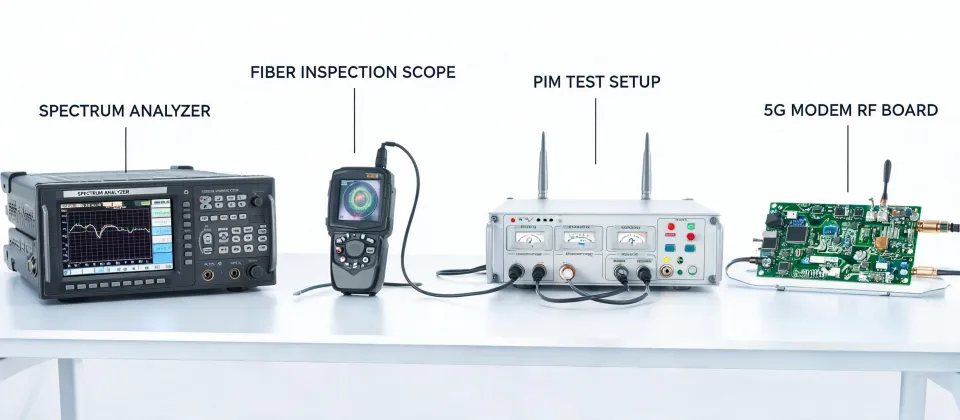
For telecom planning, the article should be read with protocol context in mind: 3GPP TS 38.xxx for radio behavior, IEEE 802.3bt for high-power PoE, ITU-T G.652.D for optical fiber assumptions, insertion loss in dB for link budget, and PIM in dBc for passive RF quality.